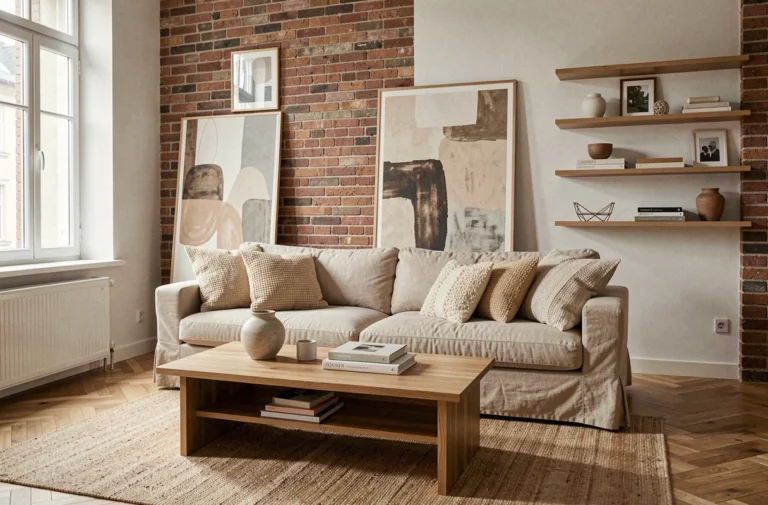
Transforming an interior doesn’t necessarily require major renovations. The decoration market has been shifting for a few years towards reversible, modular, and accessible solutions for both renters and homeowners. The following selection is based on concrete approaches, tested in the field, that allow for personalizing a living space without engaging in heavy construction.
1. Modular furniture with reconfigurable blocks
Systems made up of repositionable blocks allow the same room to be adapted for multiple uses: remote work in the morning, dining space in the evening, relaxation corner on weekends. This approach addresses the reality of compact housing where every square meter must serve multiple functions.
Field feedback varies on the durability of some entry-level models. Opt for assemblies where the fastenings remain solid after numerous disassemblies. Solid wood or birch plywood withstand repeated assembly cycles better than melamine particle board.
By exploring the decor universe on Nuxo, you will find additional ideas for arranging this type of furniture according to your room’s configuration.
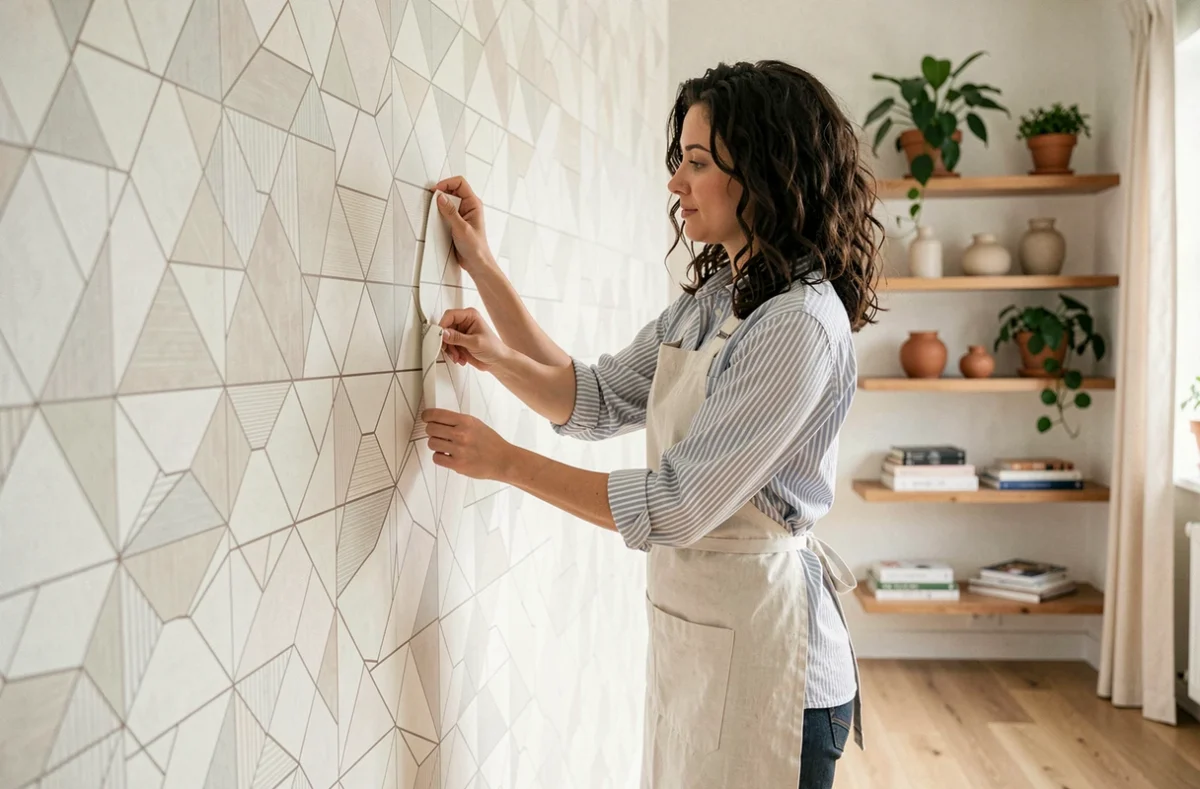
2. Repositionable wallpaper on an accent wall
Repositionable adhesive wallpaper allows you to create an accent wall without altering the original surface. This solution is particularly suitable for renters, as it can be removed without leaving visible traces.
An accent wall is enough to change the perception of an entire room. Focus on the wall facing the entrance to the room: this is the one the eye catches first. Geometric patterns or textures mimicking natural materials (caning, linen, brick) work better than overly busy prints in small spaces.
3. Repurposing and customizing an antique piece of furniture
Repainting or sanding a thrifted piece of furniture remains one of the most accessible decorative gestures. The repurposing of furniture has real potential, even if the volumes actually repurposed are still a minority compared to new items, according to data from Ecomaison reported in 2026.
An antique piece integrated into a contemporary decor creates a visual contrast that is hard to replicate with new items. The technical key: use a suitable primer for the surface (raw wood, varnished wood, metal) before applying the final paint. Without this step, the result won’t last over time.
4. Indirect lighting with LED strips
Lighting changes the atmosphere of a room more radically than a change in wall color. Self-adhesive LED strips can be placed under furniture, behind a headboard, or along a shelf without drilling or visible wiring.
Choose models with adjustable color temperature. A warm light (around 2,700 K) is suitable for the living room and bedroom, while a cooler light is better suited for a workspace. Connected systems allow you to program different ambiances according to the time of day.
5. Wall textiles in macramé or weaving
Hanging a textile piece on a wall is a great substitute for a painting in interiors that lack warmth. Macramé, artisanal weaving, or even a simple suspended Berber rug absorb some sound reverberations, a concrete advantage in apartments with smooth walls.
Adhesive hooks are sufficient for lightweight pieces. Beyond two kilograms, a suitable anchor for the surface (plaster, concrete, brick) is necessary to avoid unpleasant surprises.
6. DIY coffee table from raw materials
Making a coffee table from raw materials (a solid wood top on metal legs, a polished concrete slab on a tubular structure) yields a unique result without requiring a high budget. Table legs sold separately, in hairpin or trapezoidal styles, can be attached to any top drilled to the right dimensions.
This type of DIY project typically takes less than half a day. Sanding the top and applying oil or a matte varnish protects the wood while preserving its natural appearance.
7. Interior screen to delineate areas
A slatted screen visually separates two spaces without enclosing or reducing brightness. Made of wood, metal, or caning stretched over a frame, it can be installed on the floor without wall fixation in most cases.
- In wood with vertical slats, it adds an organic touch and partially filters the view
- In black metal, it structures the space with a more graphic rendering
- In natural caning, it diffuses light while creating a soft separation
The screen replaces drywall in rental housing where any structural modification requires the landlord’s approval.
8. Vertical greening with a plant wall
An indoor plant wall, even reduced to a few textile pockets fixed to a panel, transforms a dead corner into a focal point. Trailing plants (pothos, ivy, tradescantia) require little maintenance and adapt to moderately lit rooms.
A common pitfall: underestimating the moisture generated by watering. Place a catch basin or waterproof felt behind the support to protect the wall. Systems with an integrated reservoir limit watering to once a week.
9. Oversized mirrors to enlarge the space
A large mirror placed on the floor against a wall visually doubles the depth of a narrow room. The effect works even better when it is positioned opposite a source of natural light.
The preferred format: a mirror whose height represents at least two-thirds of the wall. Light wood or gold metal frames integrate into most styles without creating a break. Secure it to the wall with a safety strap, even if placed on the floor, to prevent tipping.
10. Two-tone paint with a graphic demarcation line
Painting the lower third or two-thirds of a wall in a shade darker than the rest creates a modern wainscoting effect. This technique requires only a roller, masking tape, and a few hours of work.
- A high demarcation line (around 1.40 m) visually elongates the room
- A low line (around 90 cm) creates a cocooning effect, suitable for bedrooms
- A diagonal or arc line adds dynamism but requires more precision in masking
For a property completed more than two years ago, painting work may qualify for a reduced VAT rate of 10% when carried out by a professional, which lowers the cost compared to the standard rate.
Each of these transformations works independently, but their combination produces a cumulative effect. Start with one or two targeted interventions, observe the result, and then adjust: this is the most reliable method for personalizing a living space without regrets.