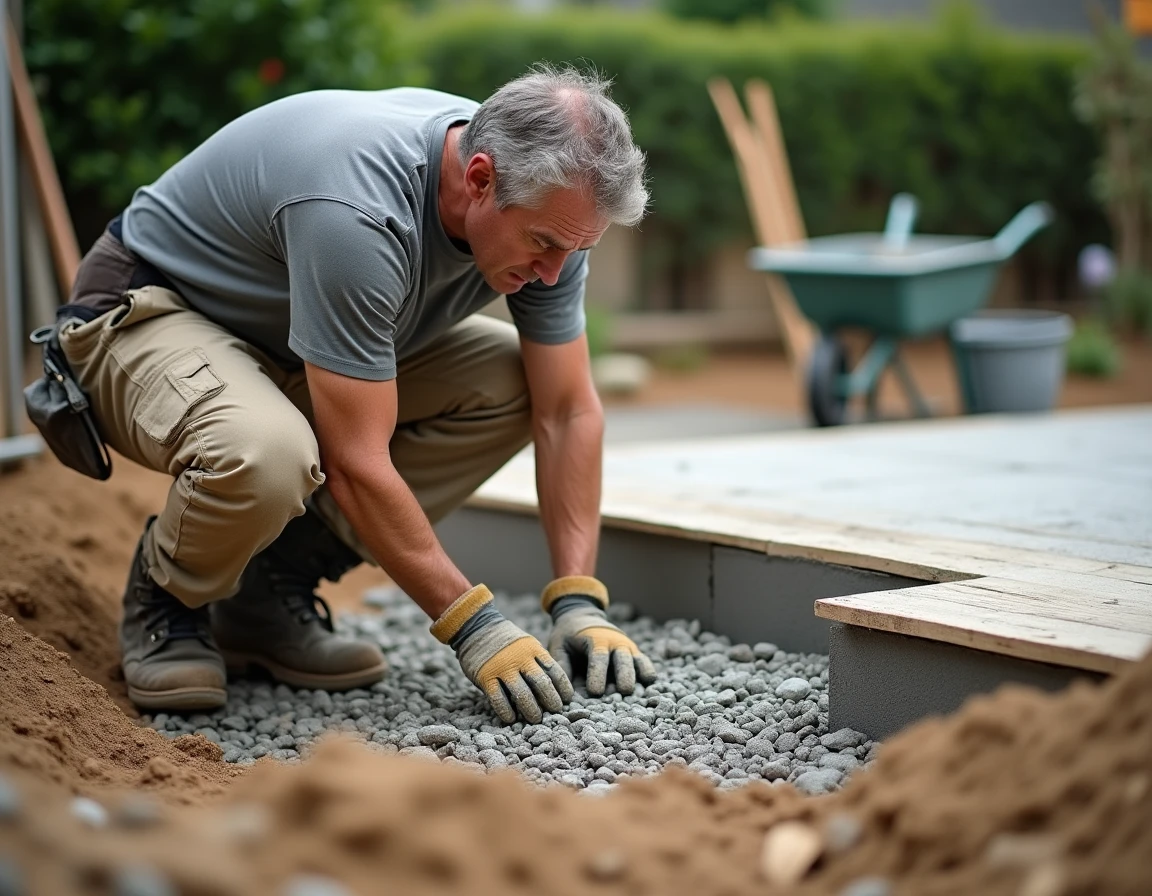
The foundation of a concrete terrace is not limited to the choice between a solid slab and pedestals. The sizing depends first on the geotechnical nature of the soil, the local frost depth, and the permanent or point loads expected on the structure. Here, we discuss the technical parameters that determine the durability of your concrete terrace foundation, starting with an underestimated risk in most guides: the shrink-swell of clays.
Shrink-swell of clays and concrete terrace foundation
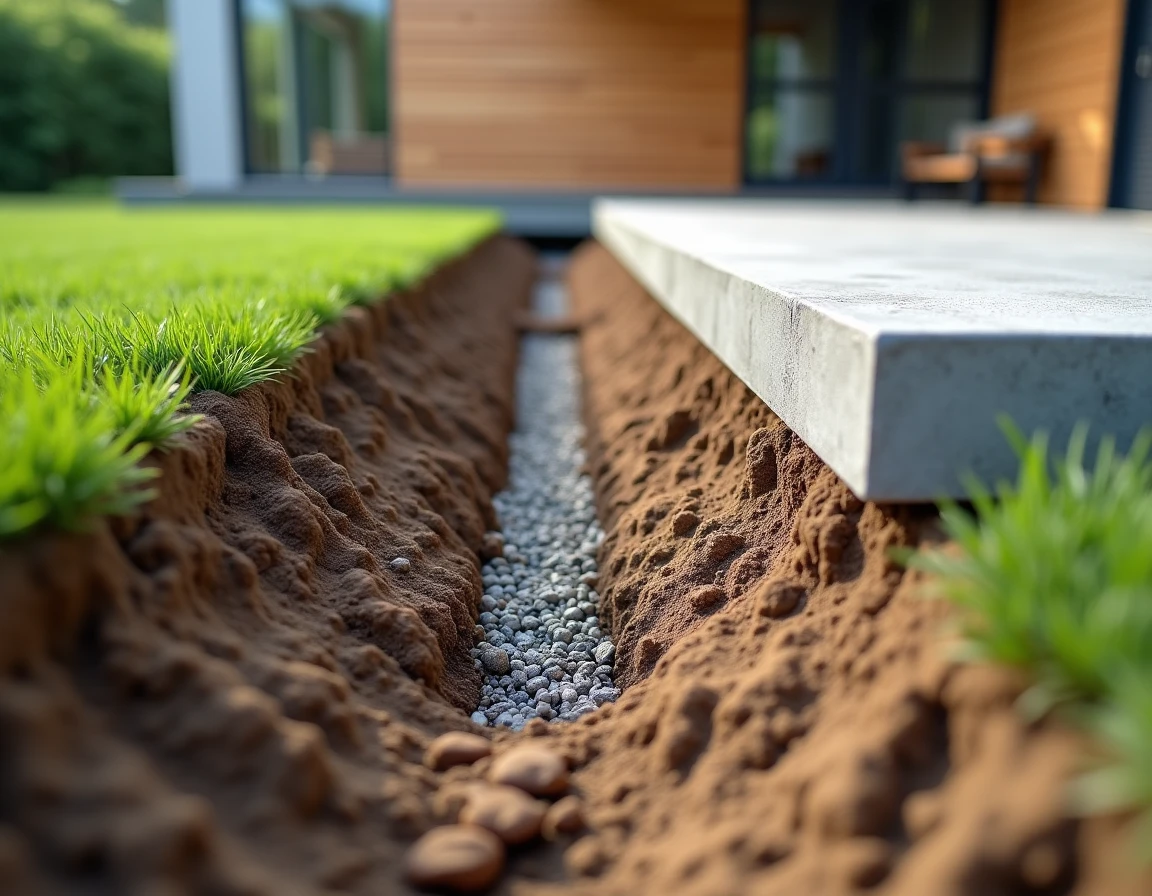
A clayey soil classified as medium to high risk changes volume with the seasons. Drought episodes cause the soil to shrink, followed by swelling when the rains return. This repeated cycle creates differential movements capable of cracking an undersized slab within a few years.
Before any project, we recommend consulting the Géorisques mapping to identify the classification of your plot. Since 2023, information campaigns from the DGPR and notes from the French Insurance Federation have reported a significant increase in claims related to drought on individual houses, and attached terraces face the same constraints as the main building.
On clayey soil, three technical precautions are necessary to protect your foundation:
- Extend the footings or pedestals beyond the drying zone, which often exceeds the simple local frost depth required by the municipality.
- Provide a separation joint between the terrace foundation and that of the house to absorb differential movements without transmitting stresses to the structure.
- Prefer a compacted and drained base soil under the slab to limit direct hydric variations beneath the structure.
If you want to learn everything about the foundation for concrete terraces, considering the local geological context remains the first criterion to validate before choosing a type of foundation.
Thickness and reinforcement of the concrete slab according to expected loads
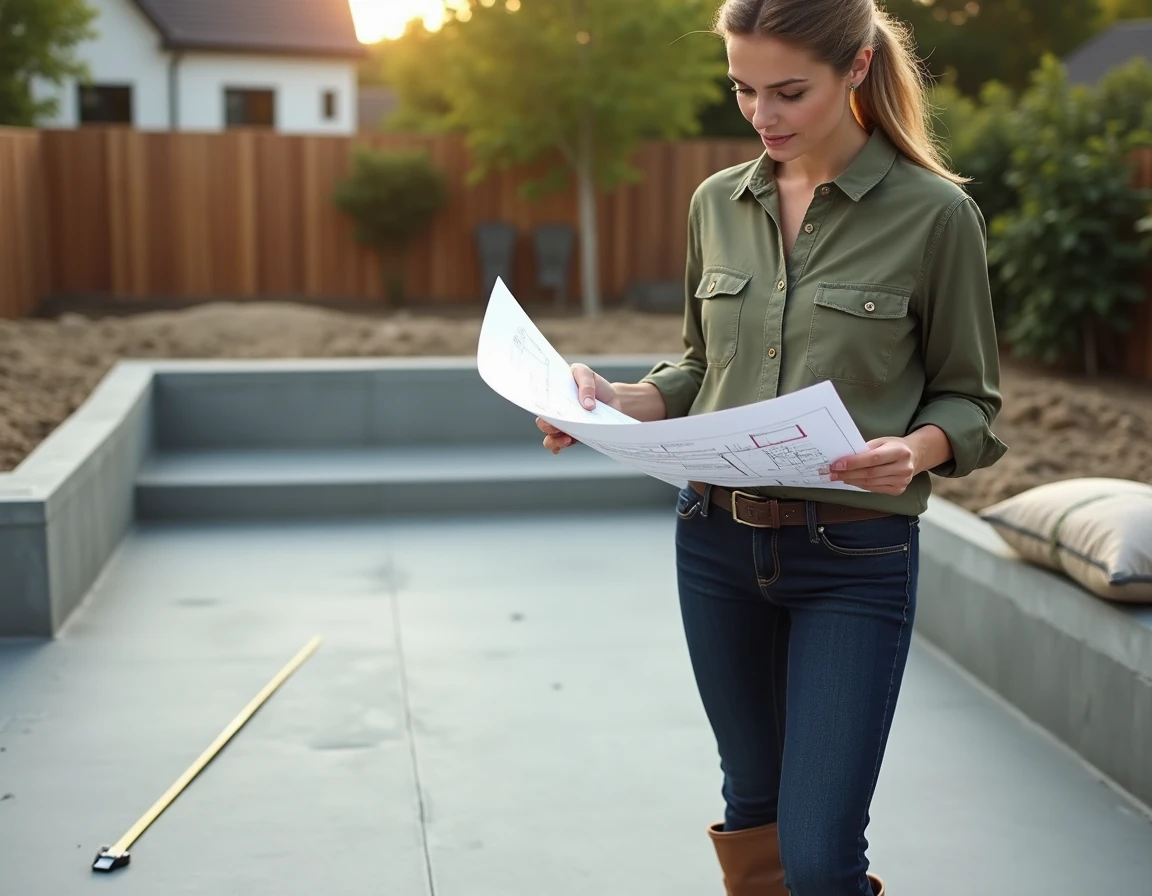
The thickness of the slab directly affects its resistance to concentrated loads. A terrace intended to support only light furniture does not have the same requirements as a terrace supporting a spa, a bioclimatic pergola, or a masonry barbecue.
For a classic pedestrian terrace, a common thickness is sufficient. However, as soon as a heavy point load comes into play, the sizing changes radically. Undersizing is the most frequent defect we observe on site: a slab that is too thin cracks under the effect of punching, especially at the support points of the pergola posts.
Reinforcement and welded mesh
Standard welded mesh is suitable for terraces without overload. For areas where concentrated loads are applied (pergola feet, spa base), local reinforcement with additional rebar is necessary. Positioning the mesh in the lower third of the slab allows it to work in tension, where concrete is naturally weak.
Poorly positioned reinforcement, placed directly on the ground without spacers, serves no mechanical function. This implementation detail makes the difference between a slab that lasts and one that cracks as soon as the first winter arrives.
Solid slab, concrete pedestals, or screw piles: which system for which terrain
The choice between these three systems depends on the soil bearing capacity, the slope of the land, and the type of final covering.
Solid slab on draining fill
The solid slab remains the most common solution for a ground-level concrete terrace. It rests on a layer of compacted gravel that ensures drainage. This option is suitable for flat or gently sloping terrains, with stable and well-drained soil. Its main advantage: it distributes loads evenly across the entire surface.
Concrete pedestals for terraces on loose soil
Concrete pedestals provide a relevant alternative on loose or slightly sloping soil. Each pedestal descends punctually into the ground until it reaches the load-bearing layer, which avoids excavating and stabilizing the entire surface. The spacing between pedestals depends on the section of the joists or beams and the allowable load.
However, on very clayey soil subject to shrink-swell, isolated pedestals are more vulnerable to differential movements than a continuous slab. The risk of tipping or gradual settling exists if the anchoring depth is insufficient.
Screw piles: speed and reversibility
Screw piles are installed without excavation or pouring concrete. They are mechanically driven into the ground until they reach a stable load-bearing layer. The resistance of a screw pile depends on the torque achieved during installation, which directly reflects the bearing capacity of the soil at depth.
This solution is suitable for sloping terrains, rocky soils close to the surface, or projects where reversibility is a criterion (protected areas, rental lands). The unit cost is higher than that of a concrete pedestal, but the savings on earthworks and construction time often offset the difference.
Site sizing: frost depth and drainage
The frost depth varies according to the geographical area and altitude. It determines the minimum level to which any foundation must descend to avoid uplift due to frost. Ignoring this data exposes the terrace to visible deformations as early as the first harsh winter.
The peripheral drainage of the foundation is another often-neglected parameter. A terrace attached to the house without peripheral drainage accumulates runoff water against the wall, which exacerbates capillary rise and accelerates the degradation of concrete and coverings.
We recommend systematically planning:
- A layer of draining gravel under the slab or around the pedestals, thick enough to evacuate rainwater towards an outlet.
- A minimum slope of the slab directed away from the house to prevent stagnation.
- A geotextile between the natural soil and the fill to prevent the rise of fine clays into the draining layer.
Without appropriate drainage, even a properly sized foundation will deteriorate prematurely. The soil around the terrace must be able to drain water as effectively as the soil beneath the terrace.
The choice of a concrete terrace foundation relies on three concrete data: the nature of the soil (clayey, sandy, rocky), the local frost depth, and the loads that the terrace will need to support. Cross-referencing these three parameters before choosing between slab, pedestals, or piles avoids costly corrections a few years after construction.