
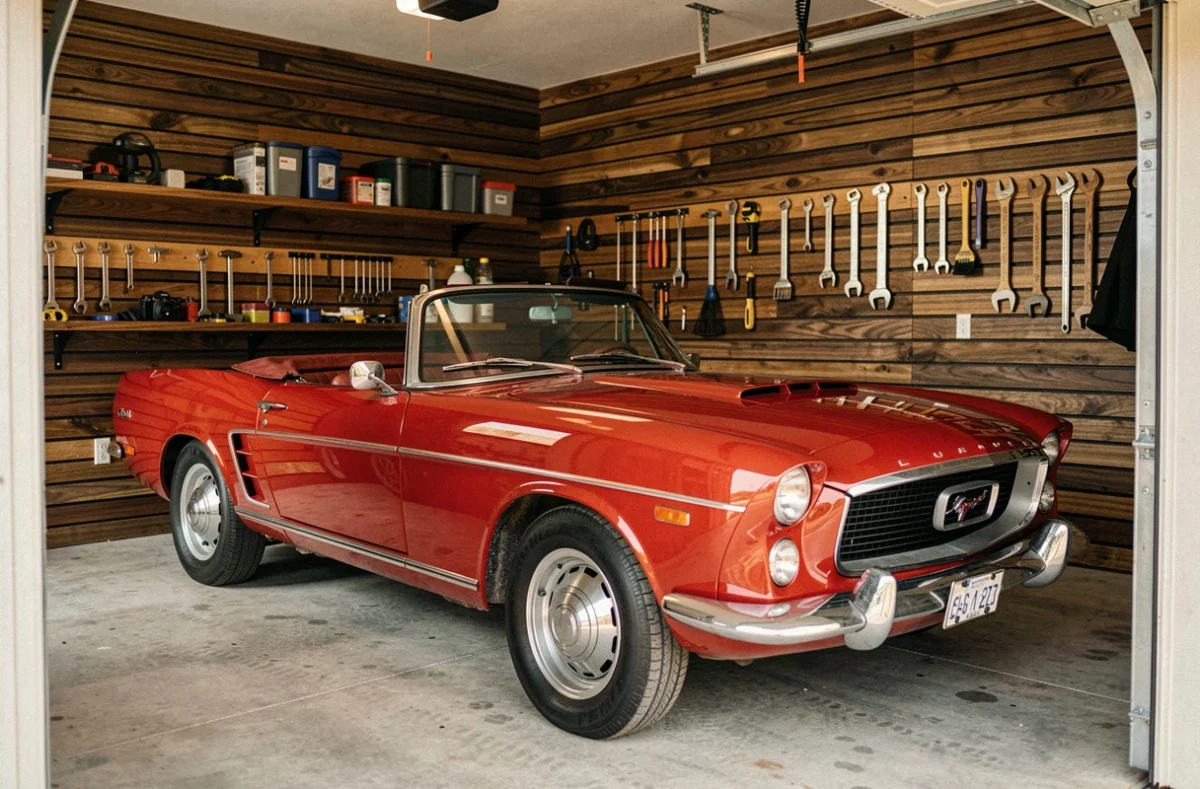
Car dealerships and automotive workshops are updating their spaces with materials once associated mainly with residential interiors or hotels. Wood panelling, long confined to house façades and domestic interiors, is now appearing on garage reception walls, in premium-brand showrooms and even in vehicle preparation workshops.
This move into the automotive world is part of a broader trend to upgrade retail spaces, where the customer experience matters as much as the product on display.
Fire safety regulations in automotive showrooms: wood comes with conditions
A showroom open to the public is a public-access building (ERP). Choosing wood wall cladding is therefore about more than aesthetics: it also affects the premises’ compliance with fire safety regulations. The decree of 25 June 1980 sets out the general framework, while the Type M provisions apply to shops and retail spaces.
The material’s reaction-to-fire rating, its thickness, the installation system and whether there is an air gap behind the cladding are all factors that determine whether the fire safety committee will approve the use of wood. Solid oak panels and engineered wood panels do not have the same fire rating, and fire-retardant treatment further affects the result.
Designing a modern garage with wood panelling therefore means aligning the design concept with a building control body or an architect experienced in ERP standards before choosing the wood species or finish. Dealerships that skip this step risk being turned down during the fire safety committee’s inspection, delaying the opening and increasing costs.
Wood traceability: the European EUDR and the automotive supply chain
The European Union Deforestation Regulation (EUDR) covers wood and certain derived products. Businesses that import or sell these materials must be able to document their origin and demonstrate compliance. However, the regulation’s implementation timeline has been postponed, and its precise scope varies depending on the type of operator and product concerned.
For a showroom fit-out company or a dealership ordering solid wood wall panels, the question arises at the outset: can the supplier provide the required traceability documentation? Forest certifications (PEFC, FSC) are useful indicators, but EUDR compliance requires traceability for each individual batch, not just a generic label.
The issue goes beyond brand image. A showroom displaying exotic wood without being able to verify its origin could face administrative penalties once the regulation is fully applicable. Exact deadlines still need to be confirmed for each operator category, making regulatory monitoring essential for any project launched in 2026.
Garage acoustics and wood panelling: what the material really changes
A mechanical workshop generates constant noise: compressors, impact wrenches and vehicle lifts. Wood has natural sound-absorbing properties, but how effective it is depends greatly on the setup.
- Solid wood panels installed directly on a concrete block wall absorb some sound reflections, but do not soundproof the adjoining room. Absorption and sound insulation are two distinct things.
- Adding an absorbent layer (mineral wool or compressed wood fibre) behind the panels significantly improves performance. Panels alone are not enough in a noisy workshop.
- The customer reception area, separated from the workshop, benefits most from wood cladding: visitors notice a marked improvement in acoustic comfort thanks to reduced reverberation in a quieter space.
- Grooved or perforated panels designed for acoustic performance are more effective than smooth panels, but have a different appearance.
Wood panelling in an automotive garage is therefore best planned by area. The sales floor and waiting room warrant a combined investment in acoustics and aesthetics. In the workshop, by contrast, resistance to splashes and impacts comes first, with acoustics a secondary concern or one that requires a dedicated treatment.

Wood panelling in showrooms: aesthetics, flooring and automotive design coherence
Wood does not work in isolation in a showroom. Successful integration depends on how well it complements the flooring, lighting and display furniture. Light oak panelling behind a dark-coloured vehicle creates contrast that highlights the bodywork’s lines. The same panelling in a poorly lit space or alongside glossy resin flooring can have the opposite effect.
Dealerships that have adopted wood in recent years use it in different ways:
- As an accent wall behind the flagship vehicle, covering a limited area to draw attention without making the space feel heavy.
- As full cladding in the lounge area, paired with contemporary furniture to extend the brand experience beyond the vehicle itself.
- As exterior cladding, combined with mineral materials, to signal a premium positioning from the car park.
Wood panelling acts as a visual cue for a more premium offering. In a sector where retail spaces increasingly follow the standards of high-end hospitality, wood is gradually replacing wall tiles and painted plasterboard partitions.
Maintenance in automotive environments
Oil, brake dust and fingerprints are common sources of wear in automotive spaces. A matt polyurethane varnish or hardwax oil provides suitable protection without compromising the wood’s natural appearance. Highly glossy finishes show marks more readily and stray from the desired look.
Regular cleaning with a neutral product is enough in reception areas. Panels installed near a workshop, however, need periodic refinishing, with the frequency depending on the type of activity and level of exposure.
Fitting out a garage or showroom with wood panelling is about more than decoration. Fire safety regulations, material traceability and acoustic performance are three technical requirements that must be factored in from the outset. Ignoring them can lead to costly remedial work or a finish that does not stand the test of time.