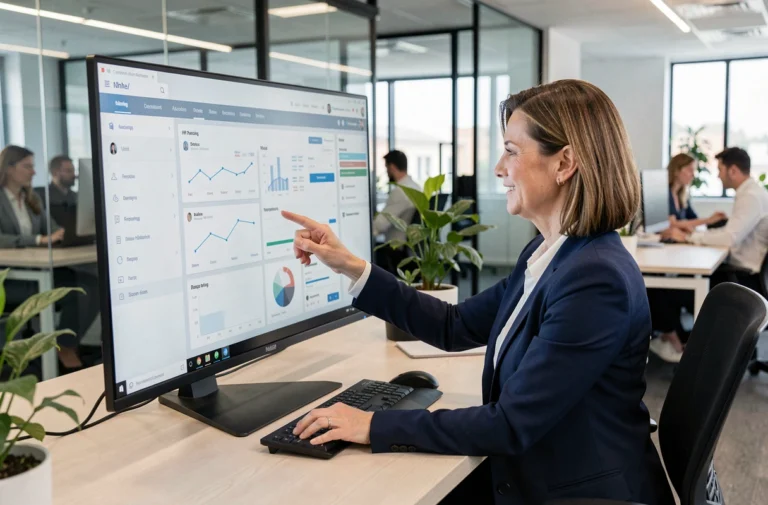
What differences in results are observed between a company that implements a standardized health prevention program and another that opts for a tailored approach? This question is even more pressing as hybrid formats, combining in-person and digital elements, have multiplied since 2025. Measuring these differences helps to understand why personalization is gaining ground among professionals concerned with occupational health, but also why it has not yet benefited everyone.
Hybrid programs in occupational health: results observed since 2025
The annual barometer of Prevention and Occupational Health Services (SPST), published by CARSAT Île-de-France in March 2026, reports a marked decrease in stress-related sick leave in SMEs that have adopted hybrid programs (in-person and digital) since mid-2025. Team engagement is described as significantly higher than that of programs that are solely in-person.
This observation can be explained by the flexibility of the format. An employee can access a stress management or risk prevention module from their workstation, without waiting for the next medical visit. The occupational physician, for their part, has continuously collected data to adjust their recommendations.
To explore this type of device tailored to the specific needs of a company, Just Healthy’s offers provide modular pathways combining physical support and digital tools.
| Criterion | Standardized Program | Tailored Hybrid Program |
|---|---|---|
| Adaptation to the workstation | Generic content, identical for all employees | Targeted modules according to the professional risks of the position |
| Digital accessibility | Often limited to a classic intranet | Digital platform accessible on mobile and computer |
| Medical follow-up | Periodic visits without intermediate data | Continuous collection, adjustment between visits |
| Employee engagement | Variable participation, often perceived as mandatory | Better engagement due to personalization |
| Initial cost | Lower | Higher, but observable return on absenteeism |
This table summarizes the most frequently documented gaps. The tailored program requires a higher initial investment, but the reduction in stress-related absences compensates for this difference over time.

Adoption in France and cultural resistance in Germany: what the OECD 2026 study reveals
The OECD comparative study “Occupational Health in Europe,” published in February 2026, highlights a clear gap between France and Germany. The adoption of tailored solutions is progressing faster in France than across the Rhine, where feedback from field experiences shows a cultural resistance to personalized approaches.
In Germany, the tradition of structured social dialogue around collective standards hinders the individualization of prevention pathways. The German employer favors a uniform framework for all employees, perceived as fairer.
In France, the opposite logic is gradually taking hold. Companies that invest in tailored prevention seek to address differentiated needs: an employee exposed to physical risks in their position does not have the same expectations as a sedentary manager facing high mental load. Personalization is becoming a lever for workplace safety, not just a social benefit.
Rural micro-enterprises and inequalities in access to digital prevention solutions
The rise of digital in workplace health presents a blind spot that is rarely addressed. Micro-enterprises located in rural areas do not benefit from the same access conditions as urban SMEs.
Deficient digital infrastructure
Where internet connectivity remains unstable, hybrid prevention platforms lose much of their effectiveness. A craftsman or a farmer employing a few employees cannot deploy a digital program if the bandwidth does not allow for loading a video module or completing an online questionnaire without interruption.
- Insufficient network coverage in many rural municipalities, rendering remote monitoring tools unusable on a daily basis
- Lack of a digital reference within very small enterprises, complicating the configuration and maintenance of platforms
- Proportionally higher costs for a micro-enterprise of three or four employees than for a company of fifty employees, without possible economies of scale
A risk of widening gaps
The documented paradox is that employees of rural micro-enterprises often present more pronounced professional risks (physical work, exposure to the elements, isolation) while having more limited access to occupational health services. Digital tailored solutions risk widening this gap if no compensatory measures are put in place.
Some solutions exist. Certain prevention structures offer mobile interventions, with a doctor or nurse traveling directly to the site. Others combine paper materials and phone consultations to bypass the digital barrier.

Criteria for choosing a health prevention program for the employer
Not all programs are created equal, and selection is based on measurable criteria rather than generic promises.
- The provider’s ability to adapt content to the real risks identified during the medical visit and job assessment
- The possibility of combining formats (in-person for group workshops, digital for individual follow-up) according to the size and location of the company
- Transparency regarding monitoring indicators: employee participation rates, evolution of sick leave, employee satisfaction after each module
- Integration with the occupational physician and existing prevention services, to avoid duplication and ensure coherence of the pathway
A relevant program is measured by its results on absenteeism and engagement, not by the extent of its catalog. An employer choosing a tailored solution must demand actionable follow-up data, provided at regular intervals.
The key data remains that of the CARSAT 2026 barometer: SMEs that have switched to a personalized hybrid format report a tangible decrease in stress-related absences. For rural micro-enterprises, the challenge is not to refuse tailored solutions, but to obtain formats adapted to their infrastructure constraints. Workplace health prevention will only produce its effects if no category of professionals is left behind.